
Bringing Fiber Internet to Your Neighborhood
We’re close to beginning construction!

Neighborhood Progress
- Engineering Complete
- Collecting Easement Agreements
- Identifying Utilities
- Construction
- Fiber Installation
- Service Activation
Out of 26 Agreements Signed

Important Upcoming Dates
ASAP
Before we can begin construction, we must receive the two remaining Easement Agreements
Remaining Weeks in October
Utility locating companies will be out in the area over the next few weeks to locate and mark where all public utilities reside underground.
- PLEASE NOTE: Private utilities, such as septic tanks and sprinkler systems, are not located by these companies. If you have any private utilities, please mark them on your property by November 1st.
Week of November 23rd
Construction is set to begin in your neighborhood, bringing you one step closer to Fiber internet!
The Construction Process
Step 1: Planning & Design
The process begins with our engineering team creating a detailed plan to bring Wisper Fiber to your area as efficiently as possible. You might see our crews in your neighborhood collecting information to guide this plan. Our team determines the best way to install the Fiber – whether underground, on existing utility poles, or a combination of both. We also coordinate closely with local authorities to secure all necessary approvals and permits for the project.
Step 2: Identifying Utilities

Public Utilities: Once our construction plans are approved, public utility companies are notified to come mark the locations of water, gas, and electrical lines using small flags or temporary spray paint. Please don’t move or remove these markers—we’ll handle cleanup once construction is finished. The paint used is water-based and will naturally fade with time. Tampering with the markers will require the utility companies to re-do the work, resulting in a delay of Fiber construction.
Private Utilities: If you have private utilities such as sprinklers, an electric pet fence, or a septic system, please mark them ahead of construction to avoid any issues. Utility companies do not mark private utilities. If you notice any issues or have concerns, please reach out to us at 800-765-7772.
Step 3: Construction

Now it’s time to build our Fiber network! Based on the custom plan for your area, our crews may use specialized equipment to place Fiber along the public rights-of-way:
Aerial – on existing utility poles. For everyone’s safety, tree trimming may be required. If we need to access poles in an easement behind your property, we’ll let you know if we anticipate any issues with alleyways, driveways, or other obstacles. A majority of our Fiber builds will be aerial.
Underground – trenching cables beneath the surface. This may be done along the rights-of-way, on public easements that may be on your property, or private easements (for example, a backyard easement). Don’t worry, we’ve already worked with your town to secure the proper approvals during the planning phase.
Both – a combination of aerial and underground methods.
Not sure what a right of way is? Read about it here.
Once installation is complete, our professional team will splice and test the Fiber to ensure you have a lightning-fast, reliable connection.
Step 4: Cleanup

We know construction can sometimes be disruptive, but our crews take great care to protect your property and will clean up once the work is complete. If you have any concerns during or after construction, please give us a call and we’ll be happy to assist.
How Fiber Gets to Your Home
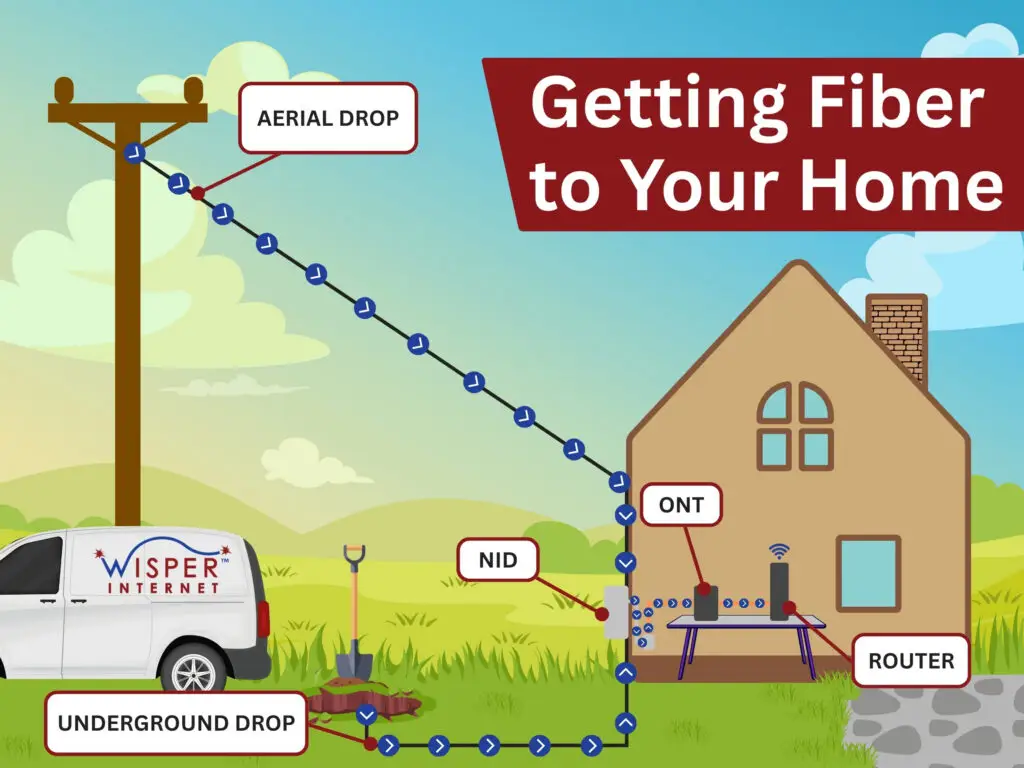
Fiber internet is brought from the main network line to your house using one of two methods, depending on your location and existing infrastructure.
Option 1: Aerial Drop (Overhead Line)
Fiber is run from a utility pole to your home through the air. This is used where overhead lines already exist. It’s typically faster to install and requires no digging. The line connects from the pole directly to the outside of your house.
Option 2: Underground Drop (Buried Line)
Fiber is buried underground from the nearest access point to your home. This is used in neighborhoods with buried utilities. It requires a small trench or bore path to place the line safely underground.
Only one of these methods is used for your installation, not both.
What Happens at the House
No matter which drop method is used, the final setup at the home is the same:
NID (Network Interface Device): The fiber line connects to a small exterior box on your home.
ONT (Optical Network Terminal): The signal is converted from fiber light signal to usable internet data.
Router: Your router connects to the ONT to provide Wi-Fi and wired internet throughout your home.